
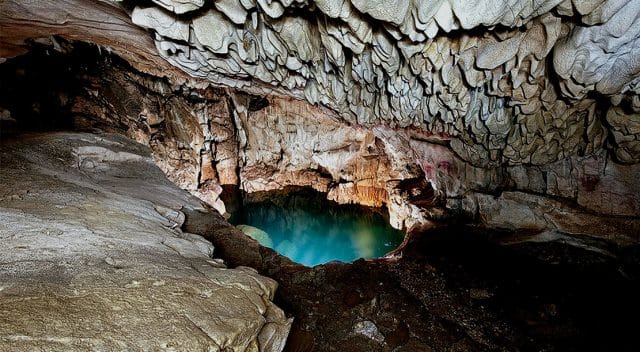
In a privileged natural region where the Lamasón and Nansa rivers, lies one of the best kept secrets of Cantabria: The Chufín Cave, The beauty of the landscape blends with thousands of years of history and art. The distance from our inn is approximately 94 kilometers, and it takes an hour to get there.
A charming natural environment
The entrance to the cave is located in a rocky cliff on the left bank of the Lamasón River, In an area of great scenic value. From a large natural shelter, a narrow passage leads to a low gallery that descends to a large room. At its deepest point, there is a permanent lake, formed after the construction of the Palombera reservoir, which flooded part of the underground channels of the karst system.
A journey to the Upper Paleolithic
The Chufín Cave It was used as a human habitat during the Solutrean period, approximately 18,000 years, and the artistic manifestations it houses also correspond to that period. In 1972, the researcher M. de Cos Borbolla discovered various cave paintings inside, and a year later the archaeologist M. Almagro Basch carried out the most comprehensive study to date, also documenting engravings on the exterior, which at that time was considered unusual in the rock art of the northern peninsula.
In 1974, archaeological excavations carried out by V. Cabrera Valdés and F. Bernaldo de Quirós revealed a large room structure in the vestibule, along with stone tools characteristic of the Solutrean, dated around 17,420 years before present.
A unique style and a legendary history
Chufín's artistic style belongs to the Paleolithic rock art, and stands out especially for its paintings in red tones that decorate a high interior ceiling, and by the engravings located at the entrance, a unique feature uncommon in other caves in the north of the Iberian Peninsula.
The cave also owes its name to the legend of the Moro Chufín, a character who, according to local residents, is said to have hidden a treasure inside. However, the real treasure is its cultural heritage, recognized in 2008, when the cave was declared a World Heritage Site. UNESCO World Heritage Site, as part of the set of Paleolithic rock art from northern Spain.
Location: 39553 Riclones, Rionansa, Cantabria (Cantabria)
For more information: Schedules and Rates | Chufín | Cuevas