
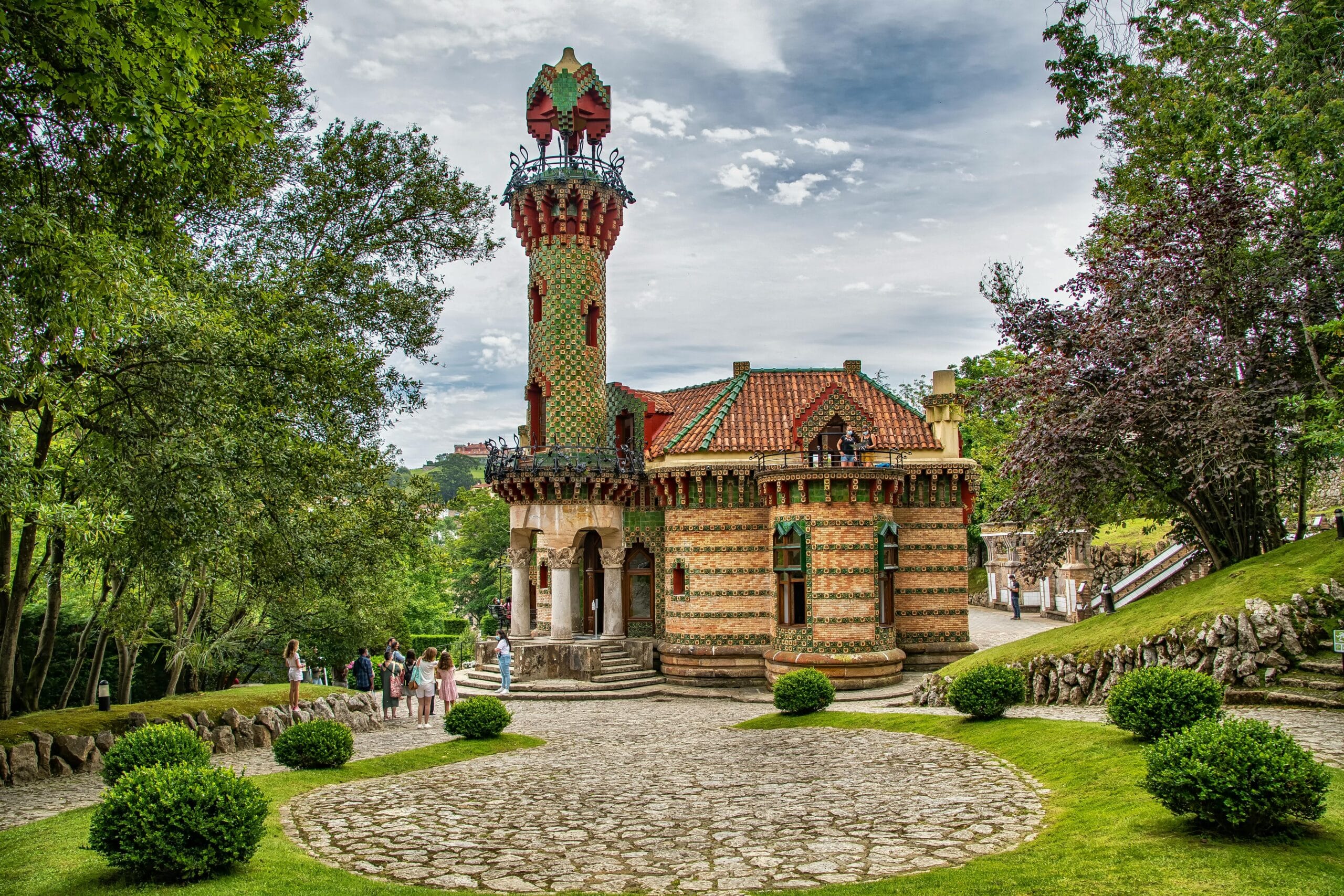
Popularly known as The Capricho, this unique building is actually called Villa Quijano, in honor of its owner, Maximo Diaz de QuijanoHe was a cultured and wealthy lawyer who made his fortune in Cuba and returned to Spain as part of the influential Indian elite of the 19th century. In addition to being brother-in-law of Marquis of Comillas, was a great lover of art, nature and music.
Moved by his refined taste and innovative spirit, Díaz de Quijano commissioned 1883 the construction of his summer residence in Quotation marks to a young Catalan architect named Antoni Gaudí, who was then taking his first steps in architecture. The building, completed in 1885, reflects both Gaudí's creativity and the eccentric and music-loving personality of its owner.
From the Río Cubas Inn, It is a 45-minute (68-kilometer) drive away.
Late 19th century, Quotation marks It became a summer resort for the Spanish aristocracy thanks to Antonio López y López (1817-1883), businessman born in Quotation marks who emigrated to Cuba at the age of 14.
Once he returned to Spain, He founded a shipping company, a bank and a tobacco company, eventually receiving the title of Marquis of Comillas.
Despite having lived in Barcelona, Antonio López He never forgot his roots. He financed the construction of several buildings, for example: The Pontifical University, the Sobrellano Palace and the Major Seminary, which was designed by the leading figures of Catalan modernism. Therefore, Quotation marks It became a cultural and architectural epicenter.
The Capricho It is one of the first works of Gaudí, And from that point on, it displayed the originality, symbolism, and blend of styles that would define his professional career. The building represents oriental art, Arabic architecture, and combines medieval elements. Furthermore, the building features bands of glazed ceramics, decorative sunflowers, and unique details.
In its tower and façade you can see the well-known trencadís, a mosaic of ceramic fragments that would later be representative in works such as the Park Güell or also the Casa Batlló.
Gaudí's Capricho It went through several stages. For example, in 1915, the original greenhouse was demolished to make way for an adjoining dormitory. In 1969, it was declared a historic-artistic monument, which allowed further modifications to be halted.
Location: Bo. Sobrellano, s/n, 39520 Comillas, Cantabria
Schedules and Rates: For more information, https://www.elcaprichodegaudi.com/horarios-tarifas